

Throughout history, art and creativity have been powerful tools of resistance – defying political injustice, preserving identity, and challenging the forces of erasure when words and weapons have been insufficient. As we witness the horror of genocide unfolding in Gaza, it becomes ever more urgent to honour and preserve Palestinian cultural memory, heritage and creativity – all of which are under threat.
For decades, Palestinian creatives have used their work to document lived experiences of exile and occupation, celebrate their identity, and express grief, resistance, and hope. From the canvas to the plate, from Tatreez embroidery to watermelons and olive trees, creative expressions of heritage and identity have served not only as a form of personal catharsis but also as powerful political acts – asserting existence in the face of systematic destruction.
At Pink Jinn, we believe that preserving and amplifying Palestinian culture is not only an act of solidarity – it is a vital form of resistance. In this post, we bring together some of the stories and work of a small number of Palestine’s most renowned and remarkable artists, celebrating creativity as a tool for memory, healing and defiance. In doing so, we aim to counter the narratives that reduce Palestinians solely to their suffering.
Instead, we hope to highlight some of the things we rarely get to celebrate: Palestine’s breathtaking beauty, its rich culture, and the creativity and generational resilience of the Palestinian people. Through this post, we hope to honour that spirit, showcase the power of Palestinian art, and support those working tirelessly to preserve their cultural heritage and document their struggle.
Sliman Mansour
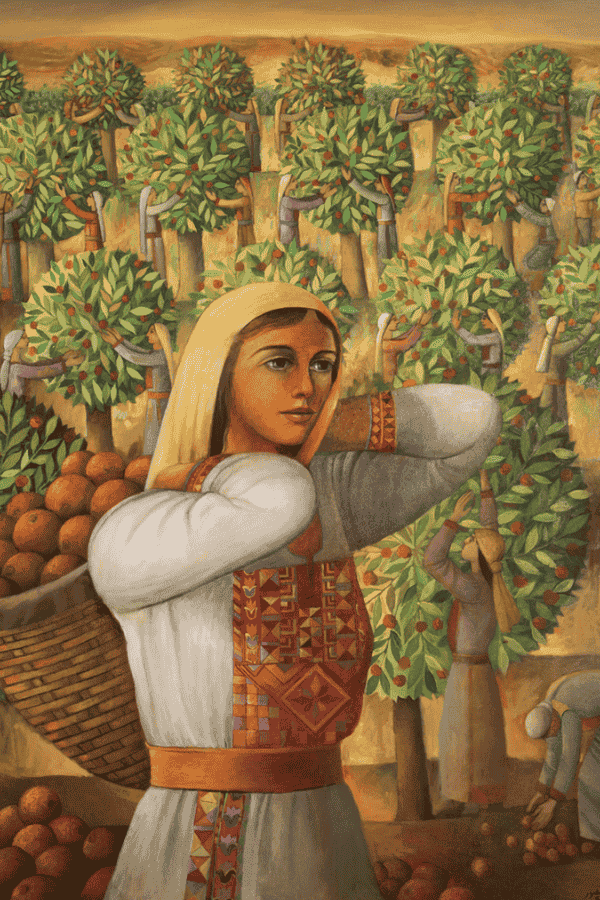
Born 1947 in Birzeit, Mansour is a seminal Palestinian visual artist whose work over more than five decades has woven together traditional symbolism – olive trees, embroidered dresses, and Palestinian architecture – and natural materials like mud, straw and henna as embodied acts of resistance and remembrance. Mansour deliberately boycotted Israeli art supplies in favour of earth-derived media, creating work that asserts sumud – steadfastness – anchored in Palestinian land, cultural identity and enduring resilience.
In this painting – Yaffa, 1979 – Sliman Mansour portrays a graceful Palestinian woman in traditional dress carrying a large basket of oranges, while others harvest fruit from lush groves – an imagery deeply rooted in memory, loss, and dignity.
Ahmad Nawash
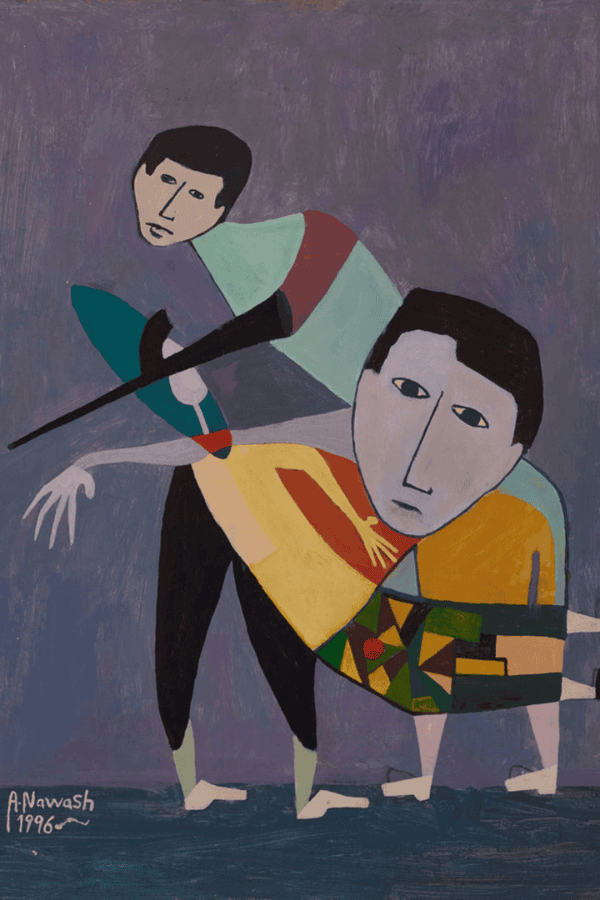
Aged 14, Palestinian artist Ahmad Nawash and his family were forced to flee their home in Ain Karem on foot after news reached them of the massacre of over a hundred villagers in nearby Deir Yassin in April 1948. As paramilitary groups advanced across Palestine, his family fled across the River Jordan and found shelter in the Jordanian town of Salt, before settling in Amman.
Searching for a means to process his loss and trauma, budding young artist Nawash studied fine art in Rome, Paris and Florence, before returning to Amman where he became a key figure in the arts scene of the Middle East. His work, full of fragmented bodies and distorted symmetries, is best summed up by fellow artist Kamal Belloul, who described Nawash’s art as a means to “reveal the hallucinations of one unable to scream.”
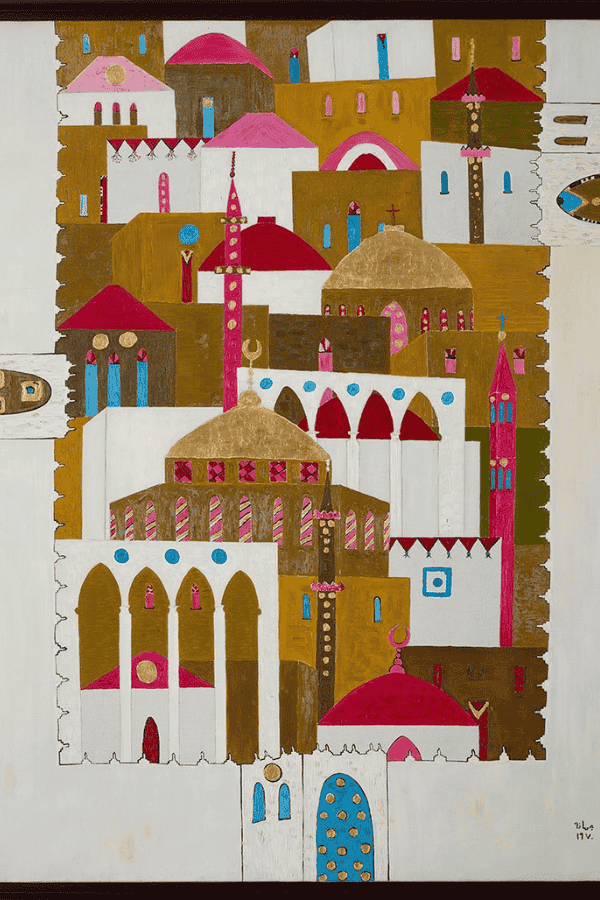
Jumana El Hosseini
Artist Jumana El Hosseini was born in Jerusalem, Palestine in 1932 and her family can proudly trace their roots in Palestine back to the 13th century. Barred from returning to their homeland after the Nakba of 1948, El Hosseini and much of her family settled permanently in Lebanon.
As the granddaughter of the Grand Mufti of Jerusalem in the days of the British Mandate and the daughter of a prominent figure in the Palestinian national movement, El Hosseini’s childhood was heavily influenced by the political upheaval of British rule and the rise of Zionism; her grandfather starkly opposed both British and Zionist rule, and her father was imprisoned by the British on two separate occasions. Palestine, memory and dispossession have strongly influenced El Hosseini’s work, with images of Jerusalem featuring in many of her pieces.
El Hosseini’s art has been called ‘celestial’, and frequently makes use of gold accents, Arabic calligraphy and simplified geometric shapes to emphasise the dreamlike quality of her childhood memories of Jerusalem.
Abdul Hay Mosallam Zarara
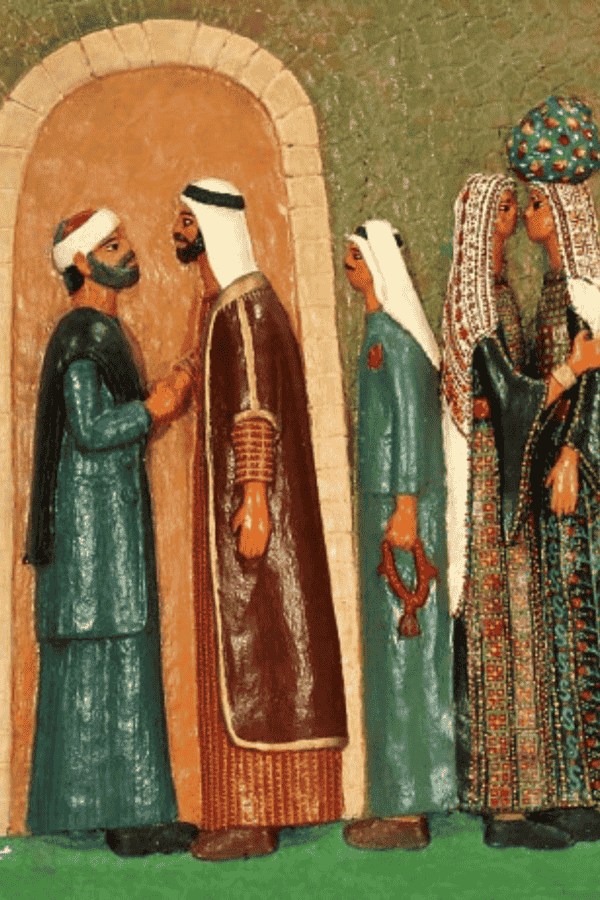
Born in Al Dawayima in Palestine in 1933, artist Abdul Hay Mosallam Zarara was forced to flee Palestine after the Al Dawayima massacre of 1948, in which over 400 people are thought to have been killed. His family escaped, and Zarara lived in refugee camps in Lebanon and Syria before settling in Jordan, where he passed away in 2020.
He used his art to record the customs and traditions of his homeland and his experiences of life in the Palestinian diaspora, filling his works with details of traditional clothing, social customs and celebrations. You might have noticed that the women are taller than the men in this piece – many of Zarara’s works subtly disrupt notions of gender hierarchies in the Middle East with techniques like this.
Laila Shawa
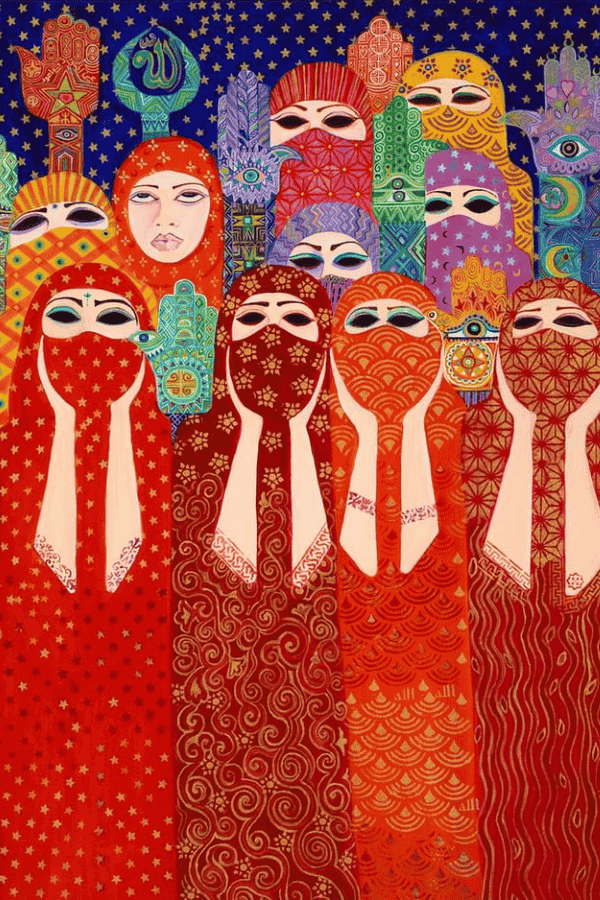
Known as the ‘mother of Arabic revolutionary art’, Palestinian activist and artist Laila Shawa was born in Gaza in 1940. Her work spanned many mediums, from sculpture to photography, silkscreens and of course paint, always with the themes of Palestine and women at the forefront of her art.
Born in Palestine in 1940, Shawa’s life and art has been shaped by the Nakba and occupation. Her powerful and varied body of work ranges from striking pop art pieces like this to sculpture, oil paintings and riffs on Islamic geometry.
Yasser Dweik
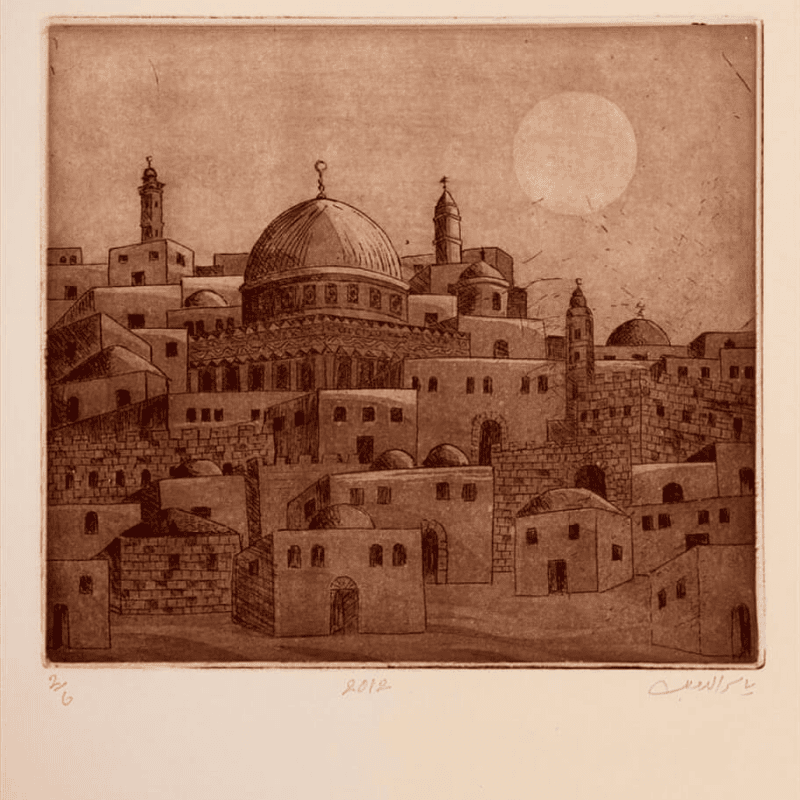
Artist Yasser Dweik was born in Hebron, Palestine in 1940. Much of his early work lovingly recorded the souqs, mosques and streets of Jerusalem and daily life in Palestine. However, during the Arab-Israeli War of 1967, also known as the Naksa, Dweik was forced to flee Palestine and seek safety in Jordan.
After his displacement, his work took on new meaning, as he processed his loss, grief and nostalgia through his work. This beautiful, whimsical sketch of the city of Jerusalem (Al Quds in Arabic) portrays the iconic Al Aqsa Mosque under the full moon.
Areej Kaoud
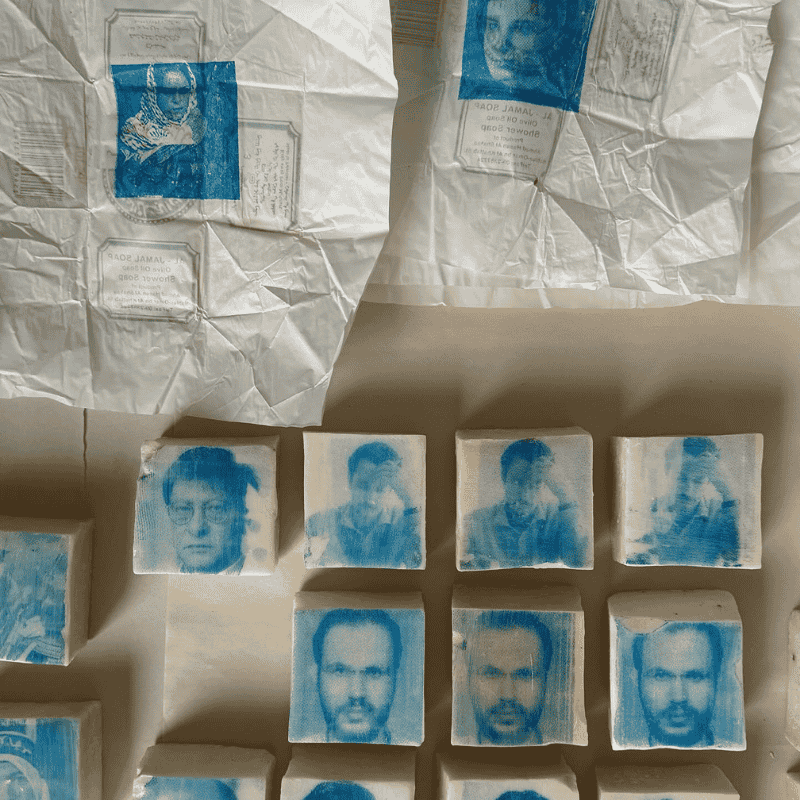
Areej Kaoud is a Palestinian‑born visual artist raised between Gaza, Sharjah and Montreal, whose multidisciplinary practice – spanning writing, performance, installation and sound – explores themes of psychology, diaspora narratives, anxiety and survival.
Using iconic Nabulsi soap blocks from Palestine as her canvas to reference ethnic cleansing, artist Areej Kaoud created this incisive and haunting work on the systematic targeting of Palestinians. Each block of soap memorialises a figure who stood for Palestinian liberation that affected the artist in her lifetime, while the shade of blue was chosen to symbolise the occupation, combining into a breathtakingly profound piece.
Nasr Abdel Aziz Eleyan
Forced out of his hometown in the mountains of Palestine in 1948, artist Nasr Abdel Aziz Eleyan grew up in refugee camps. The rural scenes of his early childhood and themes of Palestinian identity pervade his work, like this beautiful portrait of a woman wearing a thobe decorated with traditional Palestinian embroidery, known as tatreez.
To learn more about tatreez and how Palestinians around the world are preserving this beautiful piece of their cultural heritage, don’t miss our article exploring the historical and cultural intricacies of tatreez, a beautiful textile art layered with stories of identity and resistance.
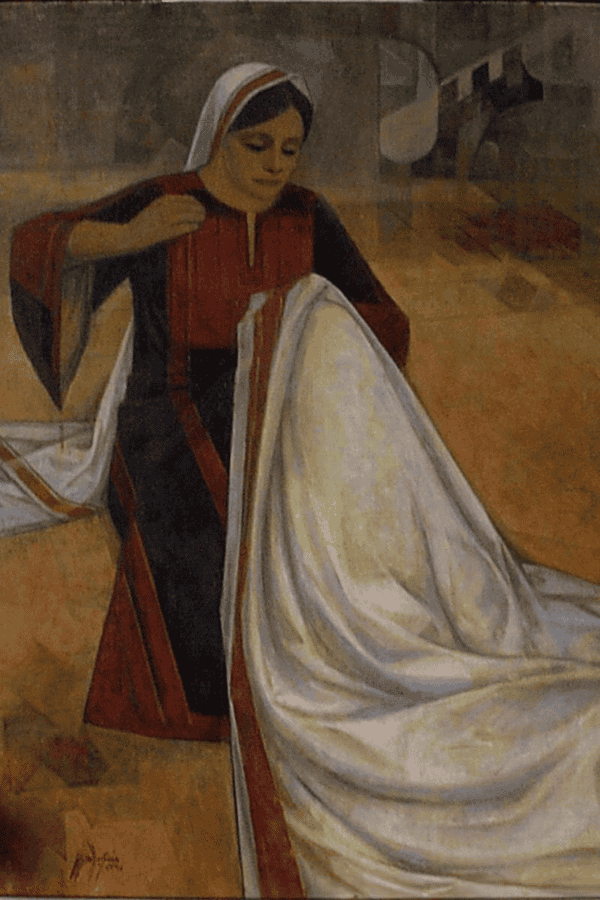
Heba Zagout
This beautiful painting of Jerusalem is by Heba Zagout. She blended her creative practice with community service, working both as an art teacher at a primary school in Gaza, and as an employee of the UN Relief and Works Agency (UNRWA).
Heba was killed by an airstrike in Gaza in October 2023, along with two of her children. Her husband, sister Maysaa Ghazi (also an educator and painter), and two other children, Faisal and Baraa, survived. Heba is known for her beautiful scenes of Palestine, and for incorporating motifs of her heritage in her work.
Her resistance to the erasure of her culture lives on through her art. As one colleague said, she was “one in a million talent” who used her creativity to help her students and family cope with life under siege.
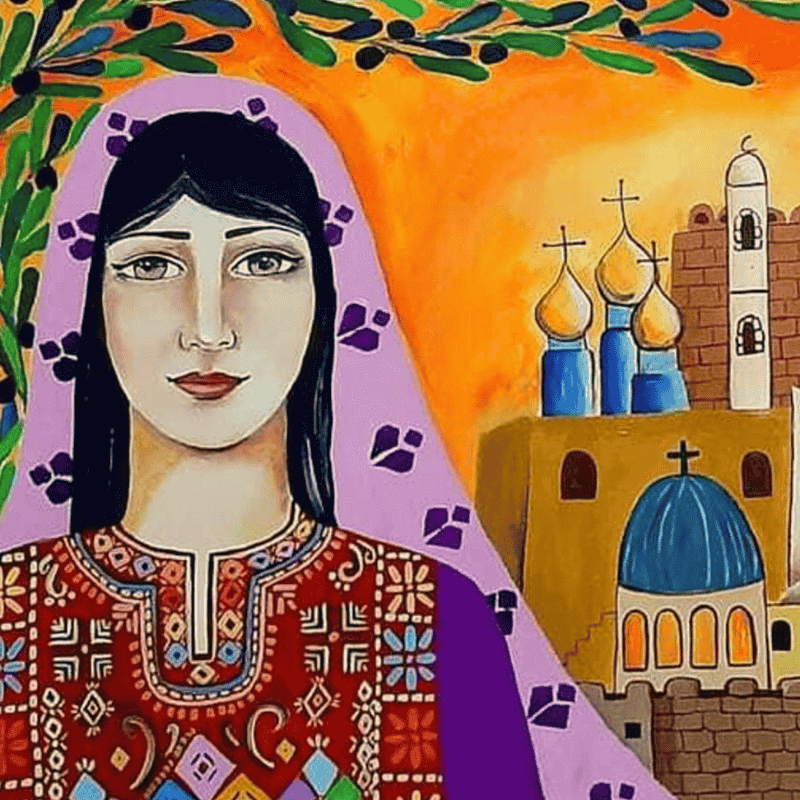
Fathi Gaben
Renowned Palestinian artist Fathi Ghaben was born in Hirbaya in 1947, Ghaben’s family fled to Gaza during the Nakba when he was only a year old, and he grew up in Jabalia refugee camp in the north of the Gaza Strip.
A self-taught artist, Ghaben’s work focused on celebrating Palestinian culture and steadfastness in the face of occupation, and many of his works aimed to memorialise the Palestinian villages, like his own, which were lost in 1948.
Gaben died in February 2024, after he was refused a permit to leave Gaza for urgent medical treatment. Shortly before he died, his home had been destroyed in an air strike, leaving many of his paintings buried under the rubble.
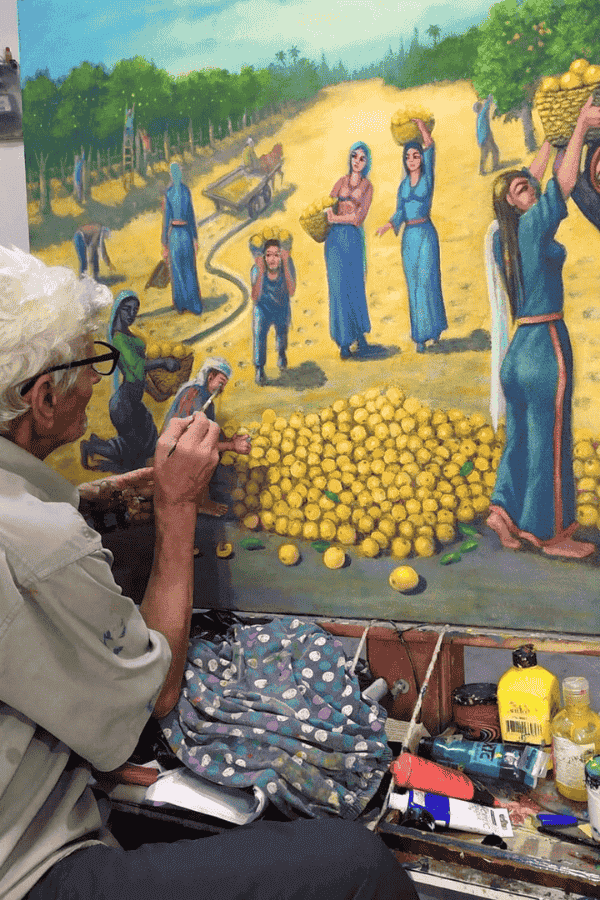
We all have a role to play in resisting cultural erasure. Whether by sharing the work of Palestinian artists, learning about their histories, or supporting platforms that amplify their voices, each of us can help protect and celebrate Palestinian cultural heritage. Art is resistance – and it’s up to all of us to make sure the world sees it.