

The coffee shop at Birkat Al Mouz had dressed itself for the occasion. Paper roses hung from the ceilings, baskets of petals sat in corners, the air already carrying that particular sweetness before we’d touched our coffee. It was our first indication that the rose harvest in Jebel Akhdar has become something more than an agricultural event.
In recent years, driven largely by social media, people have been making the trip from Muscat and across the Gulf specifically for it – the spectacular terraced farms in full bloom, and the communities on the mountain welcoming the interest, carefully, on their own terms. From Birkat Al Mouz, we began the drive up the windy mountain road – watching the temperature gauge on the car’s dashboard slowly going down, one degree at a time.
Mawsim Al-Ward – The green mountain’s pink season
Jebel Akhdar – the Green Mountain – sits in the Al Hajar range in northern Oman, its peaks reaching 3,000 metres. The altitude creates a microclimate unlike the desert below: cooler, wetter, with terraced farms carved into the mountainside over centuries, fed by an ancient falaj irrigation system that channels water from natural springs down through the villages.
It is here – in villages like Al Aqer, Al Ayn, Saiq, and Wadi Bani Habib – that ward al jabal, the Damask rose, has been cultivated and distilled for over a thousand years. The earliest written record of rose water production here appears in the 9th century, in Al-Kindi‘s Book of Perfume Chemistry and Distillation. The process has been passed between families ever since.
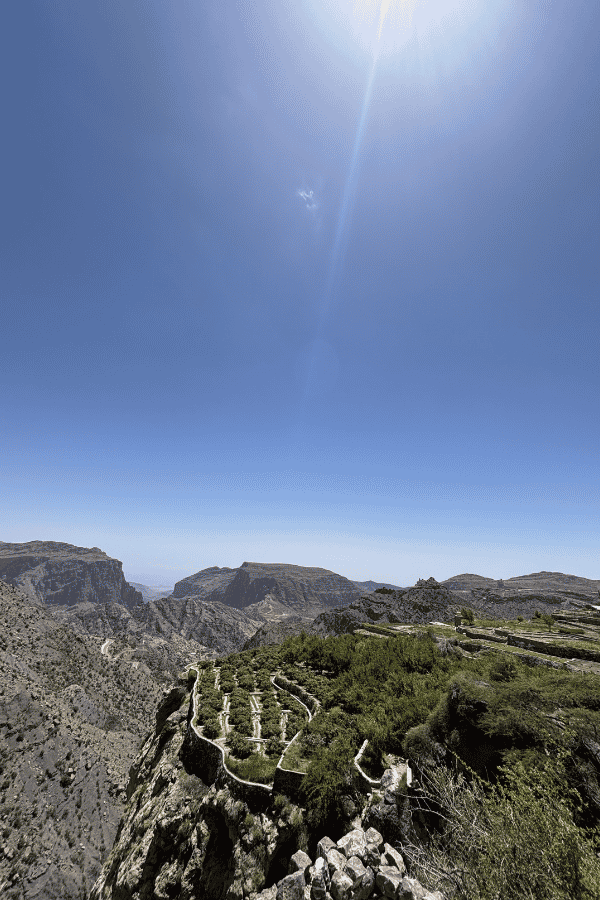
The season is short – from the middle of March through to mid-May, around 90 farms across the mountain turn pink. Picking happens at first light, before the heat of the day evaporates the fragrance from the open blooms. By mid-morning, the petals are already at the distillery.
The ancient art of rosewater distillation
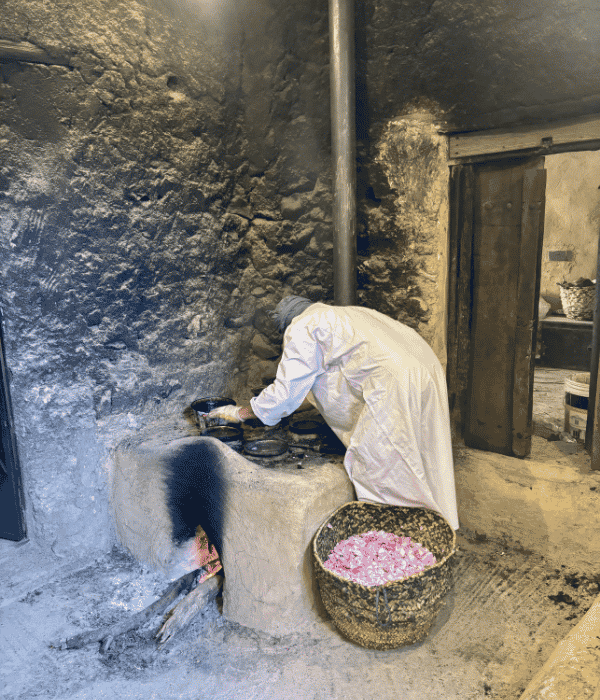
Laith’s rosewater distillation takes place in the house of his ancestors, Bait Al-Sarah, in the village of Saiq. He has been producing rose water here throughout his lifetime, learning the process from generations before him. The walls are stone, the room small. The method he uses is the traditional one – on the floor, the duhjan (a clay oven) sits low, a gas flame burning beneath it. As the petals heat, steam builds inside the vessel causing condensation, which drips down and collects – slowly, drop by drop – into a receptacle below. The result is the distinctively brown, smoky rose water that has been the mountain’s signature product for generations.
It is distinctly different from the clear rose water found in supermarkets across the region. The petals are sealed into a closed system, allowed to char slightly, and the resulting distillate carries a smokiness that is immediately recognisable once you know it – it is the flavour behind the qahwa served in Dakhiliya, the note that sets Omani halwa apart.
After the distillery, we sat in a majlis and were introduced to the full range of products made during the season: the smoky rose water, a clear version produced through a more modern distillation process, rose and frankincense perfumes, oud blends, rose skin creams. We drank Arabic coffee infused with rose water, which arrives at the cup with a faint floral freshness that takes a moment to place.
From hospitality to skincare – the magic of Oman’s rose
Rose water has been woven into Omani daily life for as long as it has been produced here – sprinkled on guests as a gesture of welcome, used in cooking and in traditional medicine, applied to skin and hair. As Sigrid van Roode explored in her piece for Pink Jinn on fragrance and personal adornment across SWANA, scent in this region carries meaning well beyond beautification: it marks hospitality, transition, the passage of time. For more on the heritage beauty ingredients of the region, see our earlier piece here.
Rose water has been used in skincare across the region for centuries, and there is ample research and evidence to support its benefits. It has natural anti-inflammatory properties, making it useful for calming irritated or sensitive skin, and its antioxidant compounds help protect skin cells from damage. It works as a mild astringent, helping to balance skin tone and reduce the appearance of redness – which is why it has long been used as a toner. Applied to hair, it can help soothe a dry scalp and add moisture. In Omani and wider SWANA tradition, it also has a role in digestion, added to drinks and sweets not just for flavour but for its mild soothing effect on the stomach.
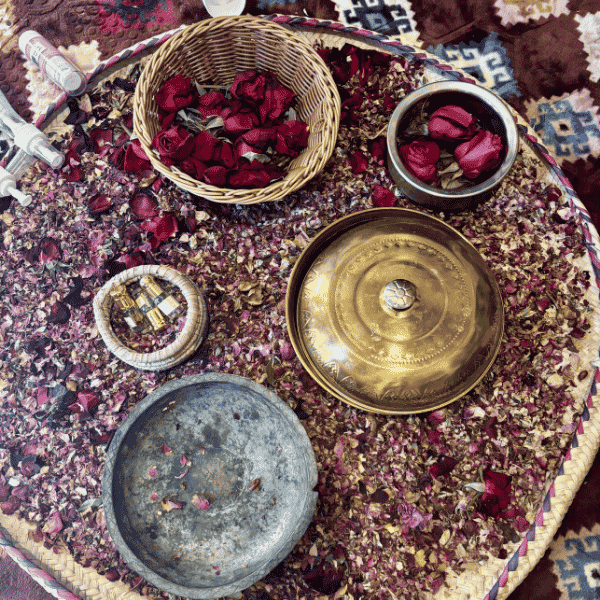
For more on heritage beauty ingredients from across the region, see our earlier piece here.
Khala Sharifa’s mountain life
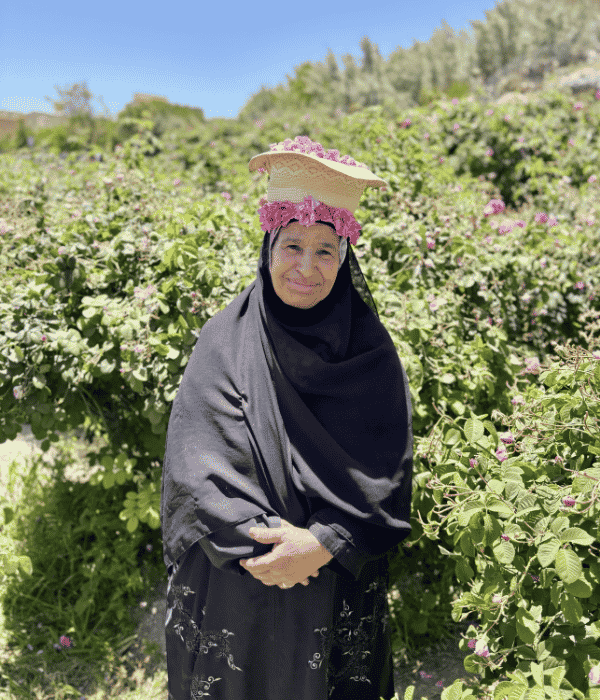
Khala (Aunty) Sharifa has lived on Jebel Akhdar her whole life. As we climbed the mountain tracks with her, she pointed to the house where she grew up in a tiny village on the mountainside. She guided us through the village to the terraced farm where the roses were in full bloom under the morning sun.
We followed her through the village of Al-Ayn to the terraces of rose bushes – low, dense, and heavy with open blooms – showing us how to pick the heads cleanly. As we picked and filled our baskets with petals, we bumped into a myriad of other visitors doing the same – an elderly aunty from nearby Nizwa who has become a social media sensation thanks to her traditional Omani bread; picture-perfect travel bloggers adorned in traditional Omani textiles, visiting from neighbouring Dubai; even a well-known Royal, wearing a low-key black outfit and baseball cap, enjoying the beauty of the mountain undisturbed by the crowds who would usually be scrambling to take her picture.
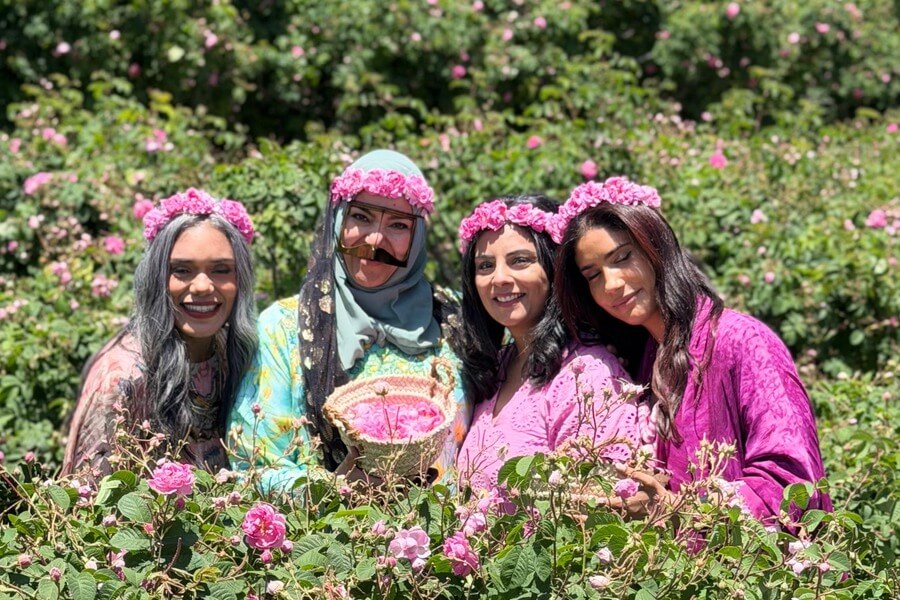
Meanwhile, Khala Sharifa walked every path with us without effort – routes she has known since childhood. What was clear, watching her move deftly through the mountain, was that the rose season for her is not a performance – unlike many of the influencers who now make the trip for the perfect Instagram post. It is simply part of her year here – an intense, concentrated period of early mornings and full baskets, of families gathered around distilleries and farms. Tourism has brought new attention to it, and with that attention, real income. But the knowledge and the labour belong to the people who have kept it alive.
We hiked the mountain trails, crossing streams, walking along the edge of the falaj, passing under ancient sidr trees, ending at the Hanging Terraces guest house. Seated on a majlis on the ground overlooking the spectacular mountainside, we ate a lunch of meat and rice cooked the traditional way, served at a communal table with our guides – Khala Sharifa chatting warmly with us as nine-year-old Rahaf from the local village performed cartwheels in the background. The meal was unhurried and generous – the kind that comes from a kitchen where recipes are spoken, passed down through generations, and where food is not merely functional – it is the glue holding communities together.
The rose season lasts about six weeks. By late May it’s over, the farms settling back into their quieter rhythms of apricots, pomegranates, and walnuts. The rose water, bottled and sealed, carries the season forward – into cups of qahwa, into halwa, into the small bottles people bring home.
Mutterah: Oman through local eyes
The day was arranged by Mutterah, an Omani tourism company offering local experiences for tourists across Oman. Founded by Omani entrepreneur Noor Al-Mandhari, her father, and their Dhofari partners – brothers Abdulhakim and Hamed – their approach is community-led, always: the guides, hosts, and producers you encounter are local people, sharing knowledge and access on their own terms.
Mutterah started as an idea on a mountainside in the southern governorate of Dhofar, where Noor and Abdulhakim were already collaborating to deliver local community tourism experiences through Noor’s social enterprise, Ghudu. Now, Mutterah offers tours across the country – from the Dhofar to Muscat via Jebel Akhdar, with experiences in the eastern province of Al-Sharqiya and the Musandam Peninsula coming soon. As well as the unparalleled local community access they offer, their logistics capabilities and extensive relationships with boutique hotels and experience providers across the country make them the perfect partner for tourists looking for something out of the ordinary – a deeper experience of Omani people and their culture.
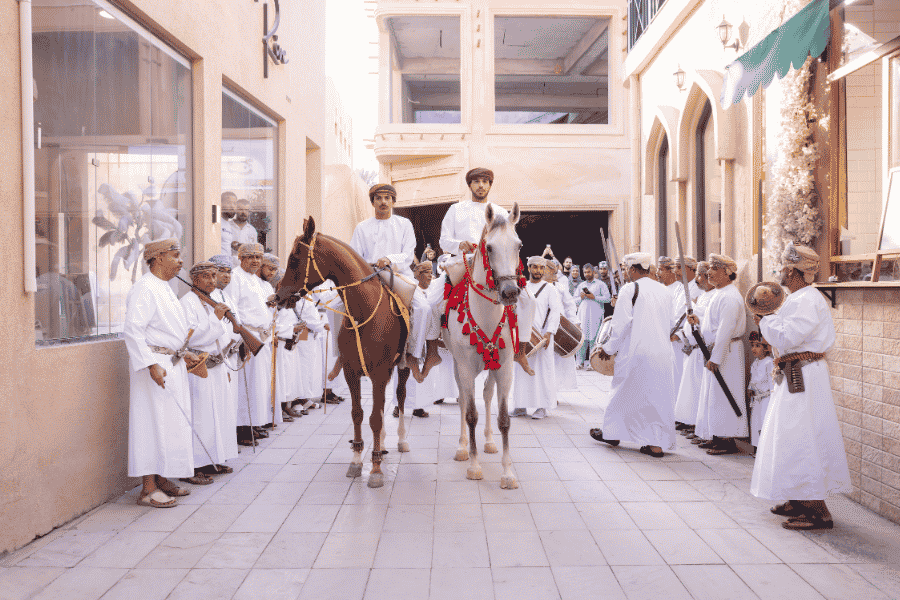
For anyone visiting Oman during the rose season, their Jebel Akhdar excursion is one of the more considered ways to spend the day. And if you missed rose season, next up on Jebel Akhdar are the apricots, olives, and pomegranates!